
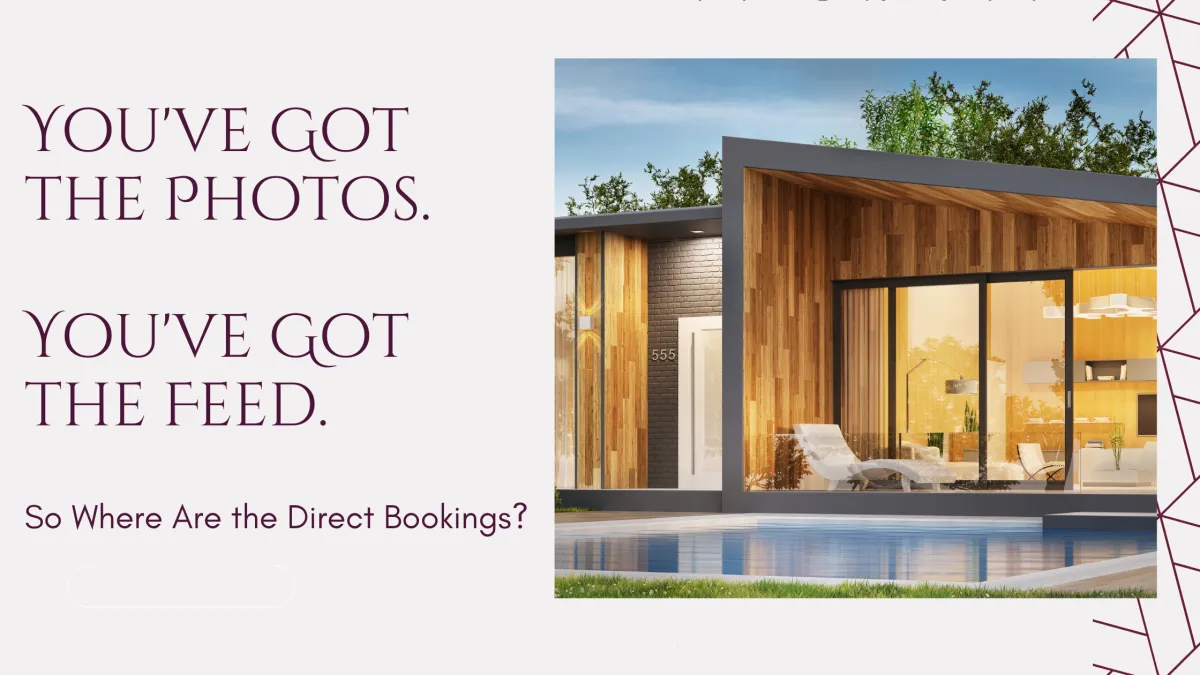
You've Got the Photos. You've Got the Feed. So Where Are the Direct Bookings?
You’ve done the work. Hired the photographer.
Styled every corner of the property.
Waited for the golden-hour light.
You’ve got a feed full of stunning images, the kind that stops the scroll and makes people double-tap before they even realize they’ve done it.
And yet… your direct booking calendar is still mostly empty.
You’re getting enough traffic through Airbnb, sure, but the independent bookings you were counting on?
The ones that would finally put more money in your pocket instead of the platform’s?
They’re not coming.
Not at the volume you expected. Not even close.
So you do what feels logical: you post more.
Better photos. More reels.
More captions about the view, the hot tub, the king-sized beds and the fully stocked kitchen.
You keep showing up, keep hitting publish, keep checking your insights to see if this one gets the traction.
And the bookings still don’t come.
Because the problem isn’t the photos.

The problem I’ve been seeing is that vacation rental owners have bought into a dangerous myth: that beautiful content alone is a direct booking strategy.
It’s not.
It’s the beginning of one.
And when owners skip from “post great photos” straight to “guests book with me directly,” they’re asking their audience to leap a chasm without ever building a bridge.
This belief keeps vacation rental owners trapped in a cycle of creating, posting, and wondering why nothing converts.
They measure success in likes and follower counts, metrics that feel good but don’t pay mortgages.
And while they’re pouring energy into top-of-funnel visibility, the back end of their guest journey, the part that actually turns interest into income, stays completely empty.
It’s like having a beautiful storefront with no door.
People walk by, admire the window display, and keep walking.
You’ve done everything right up to the point of connection, and then there’s nothing there to catch them.
I want to share a story with you.
For this example, we’ll call her Sarah, a vacation rental owner with two properties who came to me exhausted and genuinely confused about why her marketing wasn’t working.
Sarah had done everything she was supposed to do.
She invested in professional photography.
She posted consistently, three to four times a week, always high-quality, always on brand.
She even started doing Reels when the algorithm started favoring video.
Her follower count was climbing.
Her engagement was solid.
People were saving her posts.
Commenting about how much they wanted to visit.
But her direct booking site?
Crickets.
The occasional booking would trickle in, but nothing she could count on.
Nothing that gave her any sense of predictability or control.
She’d watch her Airbnb calendar fill up, and then do the math on what those bookings actually netted her after fees, and the number was demoralizing.
Despite her consistent effort, Sarah’s results were anything but consistent.
She was refreshing her Instagram analytics like they held the answer.
She started second-guessing her content, her aesthetic, her captions.
She was exhausted, frustrated, and quietly questioning whether she was just “not cut out for marketing.”
The worst part?
She was actually doing the hard part well.
The problem wasn’t her content.
Sarah felt trapped in a never-ending cycle of creation with no sustainable path from “they found me on Instagram” to “they booked with me directly.”
Because that path didn’t exist yet.
As an email marketing and content strategist who helps vacation rental owners build direct booking systems that reduce OTA dependency, this is something I see all the time.
Social media is one piece of a guest journey, and a critical one.
But it is not a complete strategy on its own.
The deeper problem is that most STR owners are working on steps two, three, and four before they’ve built step one.
They have the visibility engine running with no place to send the traffic.
No way to capture the person who saved their post.
No way to stay in front of someone who isn’t ready to book yet.
And no system to re-engage the guests who already stayed with them and loved it.
The foundation is missing, and everything else is built on sand.
I worked with Sarah to shift her approach from “post and hope” to “post with purpose and a path.”
Instead of treating social media as the final destination, we built it into the first step of a connected guest journey.
Every piece of content had a next step, a place for interested people to go, something to opt into, a reason to hand over an email address instead of just a like.
We set up a simple lead capture connected to her Instagram, a low-barrier opt-in that gave potential guests something genuinely useful in exchange for their email.
And on the back end, we built a short welcome sequence that did two things: warmed up new subscribers and reminded past guests she was still there, still hosting, and ready to take care of them again.
The transformation was remarkable.
Within a few weeks, Sarah stopped checking her Instagram follower count and started watching something far more meaningful, her email list growing, her past guests responding, and her direct booking calendar starting to fill with people she already had a relationship with.
Her marketing started working for her around the clock, not just in the moments when she hit publish.
Most importantly, she regained her sense of control.
She wasn’t at the mercy of the algorithm anymore.
She had a list.
She had a way to reach people directly.
And she had a system that kept running even when she wasn’t actively creating content.
To get some perspectives on what others were experiencing with guest experience and repeat bookings, I reached out to some connections in my network.
I asked two questions:
“When you think about the guests who have stayed with you more than once, what do you think brought them back?”
And:
“What does ‘a great stay’ mean to you as a host — and how do you know when you’ve delivered it?”
Here’s what they had to say:
Mae Naylor – Charleston Vacays, CKC Properties
“Charleston Vacay’s guests return for a consistently elevated experience they know they can trust, paired with an extensive portfolio of luxury homes to suit every stay! From seamless communication to thoughtful details, we provide everything needed to create lasting memories.”
What Mae describes isn’t a marketing strategy, it’s a relationship.
CKC Properties has built a portfolio of luxury homes in Charleston’s historic district with the kind of consistency that gives guests confidence before they even arrive.
Notice what’s at the center of their repeat bookings: trust. Not photography.
Trust.
Anna Vanderslice – Pond and Perch House
“My guests return because my property provides the ability to roam on private land with their dogs and kids, and return to a house that is clean, stylish, very well provisioned, comfortable, and safe. My guests know when they step onto my property they (and their dogs/kids) can let down and enjoy their stay.
My guests know there is a real person (team) behind the stay who care about the property and them. Meaning, while I have systems, I will also personally respond. My goal is to be supportive without being intrusive, and meet the guest at the level of interaction they want.
I know this doesn’t scale well, but it does work for 1–3 properties and honestly most people don’t own more than that (and the ones that do will approach the business in a different manner). STR is (and has always been) hospitality first. If you don’t like that part of it, then it can be a slog.”
Anna’s response is striking for what it says about connection.
Her 50-acre property on the Delaware River is stunning on its own, but that’s not why guests come back.
They come back because they know there’s a real person behind the stay.
Anna has figured out something that beautiful Instagram feeds alone cannot communicate: the feeling of being genuinely cared for.
The question about what makes a great stay surfaced equally revealing answers.
Julie Cooper – Cordland Properties
“A great stay is where the guests don’t have a need to reach out… we’ve thought of everything in advance. They are pleased and leave a 5-star review because everything met their needs.”
There’s a quiet but powerful insight in Julie’s answer.
A great stay is proactive, not reactive.
It’s the host anticipating what guests need before they have to ask.
That level of thoughtfulness can’t be conveyed in a caption about thread count.
It has to be felt.
And it’s felt most powerfully when guests hear from you again, when you reach out, follow up, and remember them.
Jay & Melissa Elliot Bayview Beach House – Fort Morgan, Alabama
“A great stay means everything is seamless and our guests can simply relax and enjoy their vacation time. No distractions. No issues. Just an effortless beach escape. I know we’ve delivered this when they don’t have to reach out during their stay, they leave a strong positive review, and they want to come back.”
Bayview Beach House, nestled on Mobile Bay just minutes from the Gulf of Mexico, points to the same north star: effortlessness.
And the proof of delivery?
The guest wants to come back. Not a follow, not a save, a return booking. That’s the metric that matters.
These conversations reveal a common pattern that every vacation rental owner would do well to sit with: the guests who come back aren’t coming back because of photos.
They’re coming back because of how they felt.
Because someone anticipated their needs.
Because they knew a real human was on the other side.
Because the experience was seamless, personal, and worth repeating.
The recurring theme I noticed was that trust and relationship are the real engine of repeat bookings, and social media, as beautiful as it is, is only the starting point of building that.
This led me to reflect on several important questions for STR owners who are still waiting for their feed to do the heavy lifting.
QUESTION #1: How many potential guests are finding you on Instagram right now, and how many of them have a way to stay connected with you after they scroll past?
It’s important because most Instagram visitors will never book on the first visit — or the second, or the third.
The buying cycle for vacation rentals is longer than one scroll. People discover a property months before they plan a trip.
If you have no way to stay in front of them during that window, you’re invisible when they’re finally ready to book.
Without a mechanism to capture their interest, an email, an opt-in, some way to keep the conversation alive, every new follower is effectively a lead that expires the moment they keep scrolling.
It’s kind of like meeting someone at a networking event, having a great conversation, and then realizing you never exchanged contact information.
The connection felt real in the moment.
But once you walk out the door, it’s gone, and you’ll have to start from scratch if you want to reach them again.
Your Instagram feed is the networking event. Your email list is the business card.
QUESTION #2: If the guests who stayed with you in the last twelve months received a personal message from you today, how many do you think would book again?
It’s important because your past guests are the warmest leads in your entire business.
They already know you.
They already trust you.
They’ve already had the experience.
Reactivating a past guest takes a fraction of the effort it takes to convert a stranger from Instagram.
But most STR owners let those relationships expire the moment a guest checks out, not out of neglect, but because there’s no system to stay connected.
Without that system, every checkout is a relationship that ends by default, and the next booking has to start from zero.
It’s kind of like a restaurant that serves you the best meal of your life and then never sends you a thing, no birthday offer, no “we miss you,” no note when they launch a new menu. You loved it. You’d go back.
But life gets busy, and without a prompt, you never quite make the reservation. The restaurant had a customer for life and just didn’t reach out to claim it.
QUESTION #3: If Airbnb changed its algorithm tomorrow and your listing dropped in visibility, how quickly would you feel it — and what, if anything, would you have to fall back on?
It’s important because platform dependency is a risk that looks invisible until it isn’t.
Most STR owners know, intellectually, that Airbnb could change the rules at any moment, and many have already felt it through fee increases, policy updates, and search ranking shifts.
But knowing the risk and having a buffer against it are very different things.
An owned email list is that buffer.
It’s the one place you can reach your audience directly, without competing in an algorithm or paying a platform a percentage of every booking.
It’s kind of like building your entire business on leased land.
The location is great, the foot traffic is real, and everything’s fine, until the landlord raises the rent, changes the terms, or someone else outbids you for the space.
The guests who know you, who are on your list, who’ve booked with you directly, they’re yours, regardless of what any platform decides to do next.
These questions reveal the fundamental problem with treating social media as a complete direct booking strategy: it puts all of your eggs in someone else’s basket.
The visibility is borrowed.
The algorithm is rented.
And the guests, even the ones who found you organically and loved what they saw — can be taken back by the feed the moment they keep scrolling.
The truth is that direct bookings don’t require a bigger following.
They require a connected system, one where social content leads somewhere, where past guests have a way back to you, and where your marketing doesn’t start from zero every time you post.
Mae, Anna, Julie, and Bayview Beach House have all pointed to the same thing: the guests who return do so because of relationship, not aesthetics.
The photos get them to look.
The relationship gets them to book.
By building the back end of your guest journey, the email capture, the welcome sequence, the re-engagement strategy, you fundamentally shift your marketing from temporary visibility to lasting connection.
And that’s what direct bookings are actually built on.
Ready to build a post-stay email sequence that works while you host?
Start building a system that creates more profitable bookings through owned relationships (not rented attention), grab my FREE → Profitable STR Playbook
A free 5-day course for STR owners who want to stand out and fill their calendar, without competing on price!
The first step is simpler than you think, and it starts with what happens in the 48 hours after your next guest checks out.
OR, if you're ready to build this out now for your STR business, book a free Review Call With Jen
